Non-Custodial in Name Only: The Fine Print That Keeps Exchanges in Control of Your Crypto
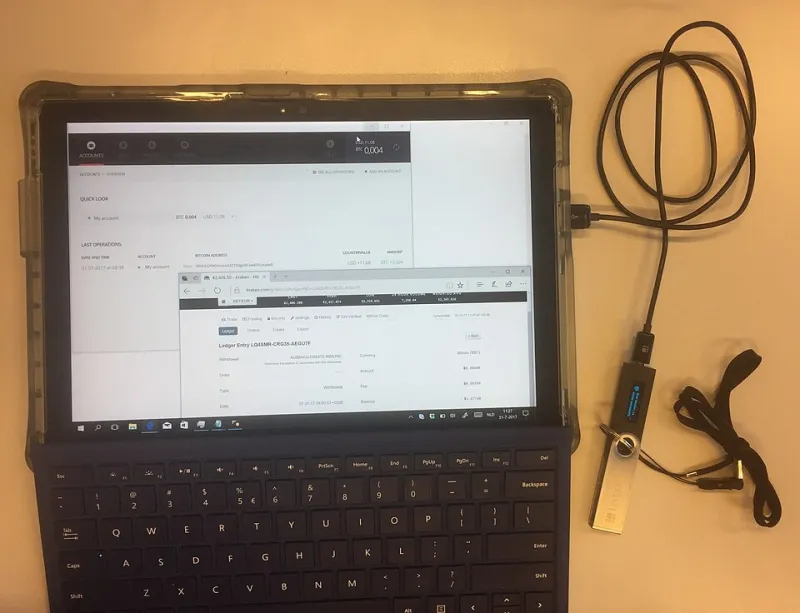
Photo: FlippyFlink, CC BY-SA 4.0, via Wikimedia Commons
The phrase "your keys, your crypto" has circulated in cryptocurrency culture for over a decade. It encapsulates a foundational promise: that digital assets, unlike bank deposits or brokerage holdings, can be owned outright, beyond the reach of institutions and their legal machinery. For most retail users in the United States, however, that promise is being quietly dismantled — not through hacks or protocol failures, but through the fine print of the platforms they use every day.
A growing number of major exchanges now market wallet features under terminology that implies user sovereignty. Words like "self-custody," "user-controlled," and "on-chain wallet" appear prominently in product copy and app store descriptions. What receives considerably less prominence is the contractual language buried in terms of service agreements that effectively preserves platform authority over those same assets under a wide range of circumstances.
What the Terms Actually Say
Reading the terms of service for several prominent US-facing exchanges reveals a consistent pattern. While platforms may generate a private key on a user's device or offer a seed phrase for backup, they simultaneously retain broad discretionary authority to restrict withdrawals, freeze accounts, or delay transactions pending internal review. The triggers for such actions are defined loosely — phrases like "suspicious activity," "regulatory compliance obligations," or "risk management procedures" appear with notable frequency and minimal elaboration.
In practical terms, this means a user can hold what appears to be a self-custodied wallet while the platform retains the ability to block that wallet from interacting with external addresses. The key may technically belong to the user, but the infrastructure through which transactions are broadcast — the nodes, the API endpoints, the application layer — remains under platform control. A key that cannot be used to move funds is, for most purposes, not meaningfully different from no key at all.
Some agreements go further, explicitly stating that the platform may comply with law enforcement requests or government orders without notifying the account holder. Others include clauses permitting the exchange to modify wallet functionality, impose new withdrawal verification requirements, or suspend services entirely with limited advance notice. These provisions are not unique to smaller or less reputable operators. They appear, in varying forms, across platforms that collectively serve tens of millions of US customers.
The Regulatory Gray Zone
The persistence of this arrangement is partly a product of regulatory ambiguity. The legal classification of cryptocurrency assets in the United States remains unsettled in important respects, and the question of when a platform is acting as a custodian — and therefore subject to the obligations that status entails — has not been answered with the clarity that would force meaningful change.
Traditional custodians operating in securities markets face stringent requirements around asset segregation, customer notification, and restrictions on the use of customer property. Cryptocurrency exchanges have, in many cases, operated in a space where those obligations either do not clearly apply or have not been enforced with consistent rigor. The result is a category of platform that enjoys the commercial advantages of custodial relationships — holding user assets on infrastructure they control — while marketing the product as something categorically different.
The FTX collapse in 2022 brought some of these dynamics into stark relief. Customers who believed they held assets on a reputable, regulated platform discovered in bankruptcy proceedings that their claims were those of unsecured creditors, not asset owners. While FTX represented an extreme case involving outright fraud, the legal mechanisms that produced that outcome — the treatment of customer crypto as platform property under certain conditions — are not unique to that entity. They are embedded, with varying degrees of explicitness, in the contractual structures of platforms that continue to operate today.
Withdrawal Limits as a Control Mechanism
Beyond the language of terms of service, the practical architecture of exchange-based wallets imposes constraints that true self-custody does not. Withdrawal limits — daily, weekly, or per-transaction caps on how much crypto a user can move off-platform — are standard features across the industry. They are typically framed as security measures, and in some contexts they serve that purpose. But they also function as a mechanism through which platforms regulate the pace at which users can exit.
During periods of market stress, these limits take on a different character. When asset prices move sharply and users seek to transfer holdings to external wallets or liquidate positions, withdrawal queues lengthen and verification requirements intensify. Several exchanges have implemented emergency withdrawal freezes during periods of heightened market volatility or internal liquidity pressure — actions that, in a genuinely non-custodial arrangement, would be structurally impossible.
The asymmetry is instructive. Platforms can move quickly to restrict outflows when it serves their interests. Users seeking to exercise what they understand to be ownership rights over their assets encounter friction, delays, and in some cases outright denial. The speed differential alone reflects where actual control resides.
What Retail Users Are Not Being Told
The marketing language around self-custody features is, in many cases, technically accurate in the narrowest sense. A seed phrase is generated. A private key exists on the user's device. These facts are real. What is omitted from the marketing narrative is the broader context that determines whether those facts translate into meaningful ownership.
For retail users — the segment most likely to rely on exchange-based wallets rather than maintaining independent node infrastructure or using hardware wallets in conjunction with self-hosted software — the distinction between custodial and non-custodial as implemented by major platforms is largely cosmetic. The private key exists, but the practical ability to exercise it independently of platform cooperation is constrained at every level of the stack.
This matters beyond the philosophical question of what ownership means in a digital context. It has direct implications for asset recovery in the event of platform insolvency, for the enforceability of user rights in legal proceedings, and for the basic question of whether a user's crypto holdings are genuinely protected from institutional interference or merely marketed as if they were.
The Distance Between Promise and Product
The cryptocurrency industry built much of its early appeal on the proposition that digital assets could exist outside the control structures that govern traditional finance. That proposition has not been abandoned — it continues to drive product marketing, user acquisition, and, to a meaningful extent, asset valuations. What has changed is the degree to which the infrastructure delivering those assets to retail users actually honors the underlying promise.
For users seeking genuine asset sovereignty, the path remains the same as it has always been: hardware wallets, self-hosted software, and direct interaction with blockchain networks without routing through exchange infrastructure. That path is available, but it requires technical engagement that most retail participants are neither equipped nor inclined to undertake.
In the absence of that engagement, the self-custody label attached to exchange wallet products should be read with the same critical attention one would apply to any other marketing claim. The question worth asking is not whether a private key technically exists, but who controls the conditions under which it can actually be used.